Seasoning oak lumber: why time matters
Freshly sawn oak is not ready for production. What happens to a board during years on stickers, why 15-20% moisture content is good news for a buyer, and what to ask the seller.
Przeczytaj ten wpis po polsku · Diesen Beitrag auf Deutsch lesen
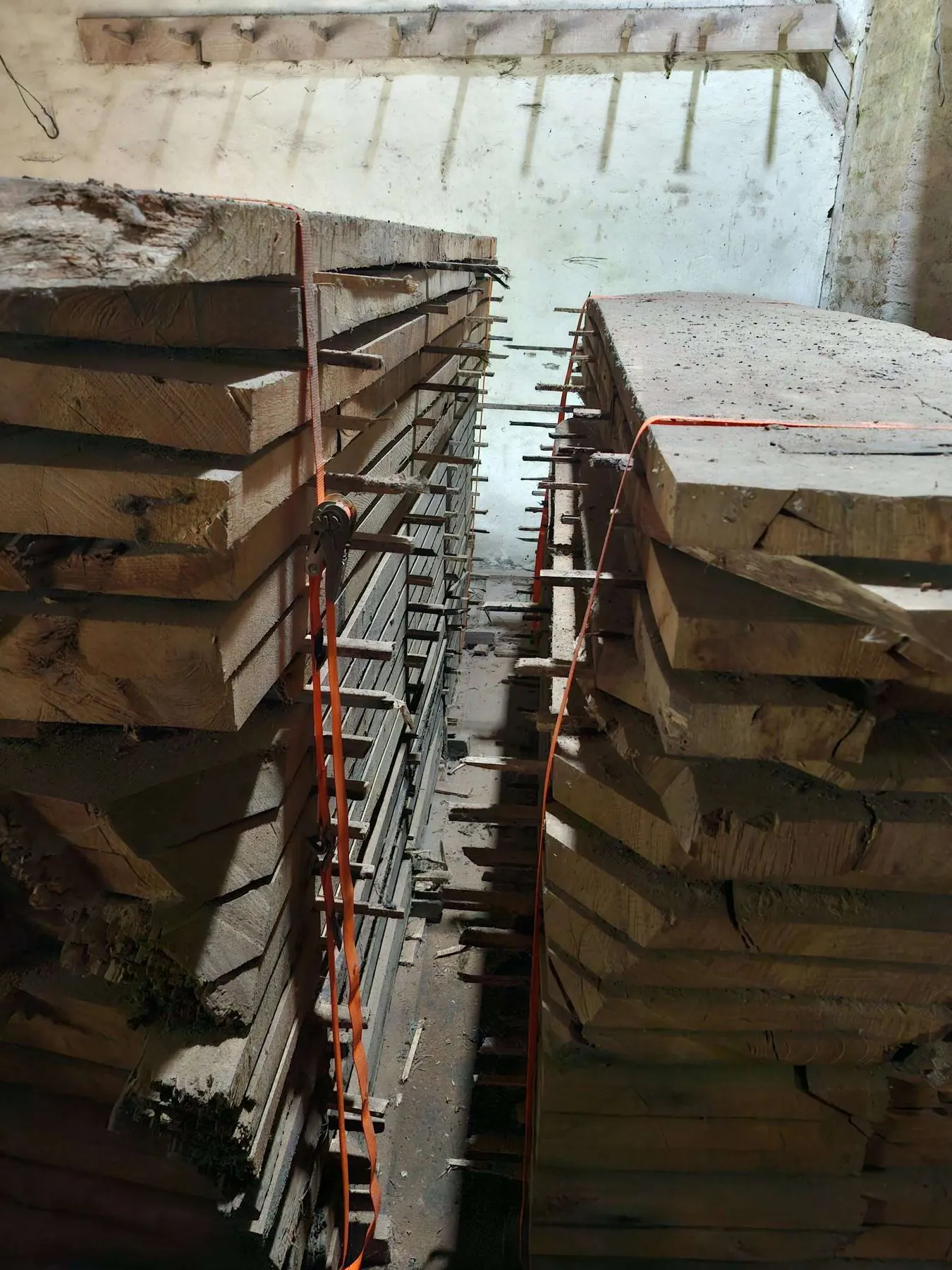
Oak is one of the slowest and most temperamental species to dry. A freshly sawn oak board holds moisture far above the fibre saturation point (around 30%), and every attempt to rush the drying ends in end checks, collapse and warping. This is why the classic way of preparing oak for production has looked the same for generations: boards go onto stickers, under a roof or a cover, and they wait.
What happens inside the stack
Air seasoning is a slow release of water to the surroundings. Stickers (strips between the layers of boards) create channels for airflow, while a top cover protects against rain and direct sun. Wood moves towards equilibrium with its environment. In a Central European climate, in the open air, that usually means somewhere in the mid teens of percent, depending on the season.
A common rule of thumb says that hardwoods air dry at roughly one year per 25 mm of thickness, and oak sits at the slow end. A 50 mm board therefore needs at least two seasons to come down from green to something close to equilibrium. Further years in the stack no longer lower the moisture content indefinitely, but they do something just as important: internal stresses even out and the material settles. That is the part you cannot buy in a kiln.
Why 15-20% is good news
Lumber at 15-20% moisture content is in the state most industrial buyers find the most convenient:
- Furniture, flooring and interior joinery usually need 8-10%. Finishing in a kiln from 15-20% is short and carries little risk of degrade, unlike kiln drying green oak, which is long and expensive.
- Windows, doors and exterior elements target a higher moisture content, so seasoned material is often ready almost immediately.
- After years on stickers a board has already shown everything it had to show: checks, spiral grain, bow and twist. Defects are visible at inspection, not after the material dries in your own warehouse.
The first lines of the ARGADO offer describe exactly this: oak (Quercus robur / Quercus petraea) seasoned for about 6 years, moisture content 15-20%, stored on stickers in proper warehouse conditions. Thicknesses of 32-55 mm fall within the range where such long seasoning makes the most sense.
What to ask the seller
Whoever you buy oak from, it is worth settling three things before you decide:
- How the moisture was measured. A pin meter reads the outer layers; in thicker boards the difference between the surface and the core can reach several percentage points. Measure a few boards from deep inside the stack, not only from the edge.
- How the material was stored. Stickers, a top cover, clearance from the ground and airflow are the basics. A stack that stood uncovered looks different from one kept in a warehouse.
- Whether you can inspect before buying. An on-site inspection is standard for large lots, and a seller who offers it unprompted saves both sides a lot of misunderstanding.
The ARGADO offer covers all three points: the material is stored on stickers, documentation and photos are available, and an inspection can be arranged before purchase. Details and the enquiry form are on the offer page.